
A core strategy for ranking high in Google SEO! We provide a detailed analysis of Lighthouse and Core Web Vitals metrics and tool usage. We cover everything regarding website performance optimization, including the meaning and improvement plans for user experience metrics such as LCP, INP, and CLS, as well as the impact of high-quality content on search rankings.
1. Essential Search Optimization Audit! Understanding Core Web Vitals and Lighthouse
Lighthouse and Core Web Vitals are the measurement items and tools used to measure web performance for Google optimization audits. They are essential for achieving high search visibility. To use an analogy, just as you must submit a resume, pass document screening, go through an interview, and finally get assigned to a department to get a job, you must first pass the document screening (Core Web Vitals). Only then can you take the interview (Lighthouse) and be placed in a good department (high-quality content ranking at the top).
Passing Core Web Vitals is the equivalent of passing the document screening, Lighthouse is the interview exam, and content is the placement in a good department. We will look specifically at the roles and importance of these two tools and learn how they can improve web page quality.
2. The Core of Google Optimization Audit: The Role of Core Web Vitals
Core Web Vitals are key metrics for evaluating user experience on web pages and serve as the minimum standards by which Google measures web page performance and quality. These metrics measure the loading speed, interactivity, and visual stability of a web page, serving as important basic criteria for Google’s search rankings.
Three Key Metrics of Core Web Vitals
Core Web Vitals consist of three core metrics that evaluate user experience. These metrics are the primary goals of web performance optimization.
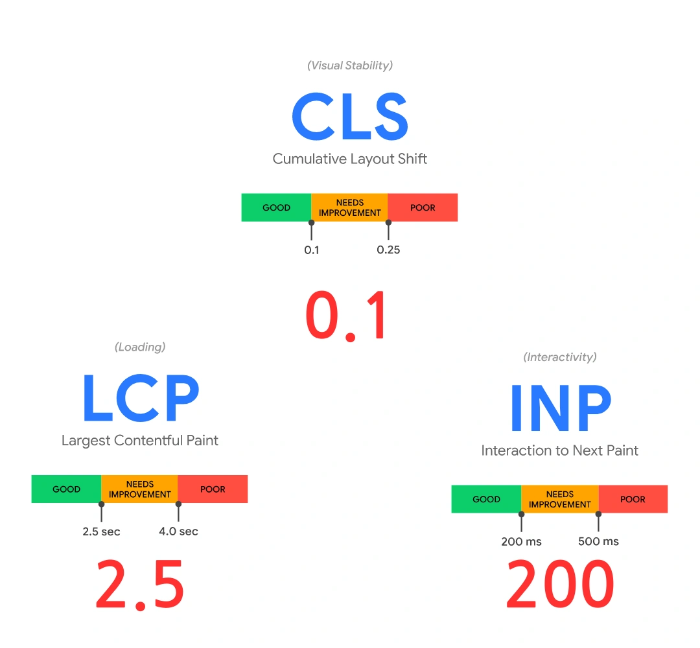
- LCP (Largest Contentful Paint): Measures the time it takes for the largest content element (image, text block, etc.) to appear on the screen. It must be within 2.5 seconds to receive a ‘Good’ rating. This is the core of loading speed optimization.
- INP (Interaction to Next Paint): (Replaced FID starting March 12, 2024) Measures the response time it takes for the browser to display the next frame when a user interacts with the page (click, tap, etc.). It must be within 200 milliseconds (ms) to receive a ‘Good’ rating.
- CLS (Cumulative Layout Shift): Measures the extent of unexpected layout shifts (shaking) that occur during page loading. It must be less than 0.1 to receive a ‘Good’ rating. This is directly related to visual stability.
Since March 12, 2024, INP has replaced FID (First Input Delay) to function as a Core Web Vital. While FID measured only the first interaction on a page, INP measures the responsiveness of all interactions throughout the entire page lifecycle, further refining the evaluation of user experience.
3. In-depth Quality Testing Tool: Lighthouse Analysis
Lighthouse is an open-source quality testing tool created by Google that provides a comprehensive report across five areas, including web page performance, accessibility, and SEO. If Core Web Vitals are the ‘minimum standards,’ Lighthouse is like a ‘comprehensive health check-up’ for a website. This tool can be easily run in PageSpeed Insights or Chrome Developer Tools.
5 Key Measurement Items of Lighthouse
Lighthouse is a multidimensional tool that evaluates the overall quality of a web page, not just speed.
- Performance: Measures website speed-related metrics such as page load speed, interaction time, and visual stability. Core Web Vitals metrics such as FCP, LCP, INP, and CLS are included in this category.
- Accessibility: Measures how easily and comfortably users can use the page. It checks for the use of alt text for the visually impaired, keyboard accessibility, clear color contrast, etc.
- Best Practices: Measures whether the web page is built according to web standard regulations and best practices (use of HTTPS, removal of vulnerabilities, prevention of console errors, etc.).
- SEO: A metric that measures how well search engines can crawl and index the page. It checks for the presence of meta tags, use of valid H tags, mobile-friendliness, etc.
- PWA (Progressive Web App): Measures whether the website meets PWA requirements. (Optional item)
Accessibility, Best Practices, and SEO are important categories where you must achieve a high score. In particular, SEO, CLS, and INP are essential for search exposure.
Deep Dive into Lighthouse Performance Metrics
The performance section of Lighthouse includes various time-based metrics in addition to Core Web Vitals.
-
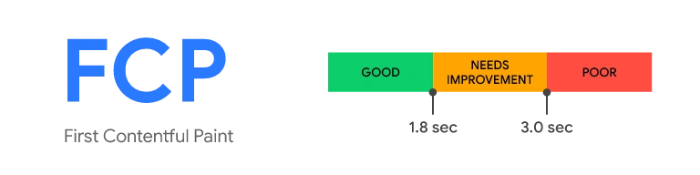
- FCP (First Contentful Paint): Measures the time it takes for the first content (text, image, etc.) to be displayed on the screen when accessing a web page. This is the first point at which a user perceives that the page is loading.
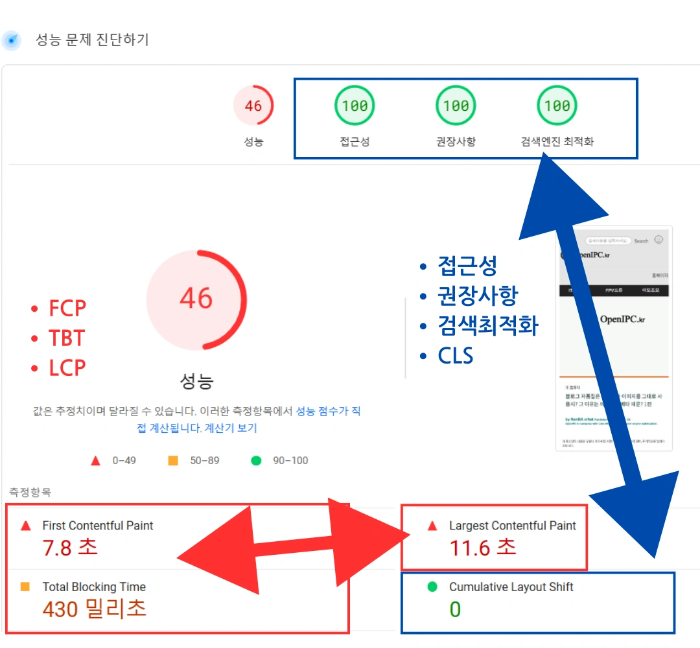
- TBT (Total Blocking Time): Measures the total time during page loading when the main thread is blocked and unable to respond to user input. This is closely related to INP and is mainly caused by long JavaScript execution times. Since external code must be modified, it should proceed as an overall system optimization.
- LCP (Largest Contentful Paint): Measures the time it takes for the largest content to be displayed during page load and is a key metric of Core Web Vitals. LCP can be improved through font optimization, image compression, and lazy loading.
- CLS (Cumulative Layout Shift): Measures layout stability during page loading and is a key metric of Core Web Vitals. Layout shifts should be prevented by specifying size attributes (width, height) for images or designating a minimum height for ad/iframe areas.
- INP (Interaction to Next Paint): Measures the performance of responding to user operations (button clicks, link clicks, etc.) and is a key metric of Core Web Vitals.
4. Beyond Technical Optimization: The Importance of High-Quality Content
Passing Core Web Vitals and achieving a high Lighthouse score means passing the search engine’s ‘document screening’ and ‘interview.’ However, what ultimately determines high search rankings and long-term traffic is high-quality content.
While technical optimization is the process of making a web page ‘fast and safe,’ high-quality content is the process of making a web page a ‘valuable and reliable source of information.’ Among web pages that meet technical standards, search engines assign final ranking weight to content that provides the most useful and in-depth information to users.
[Image illustrating E-E-A-T principles for SEO]
Interaction of Final Ranking Determination Factors
The final content quality is checked before determining the ranking. Technical performance and content quality interact as follows:
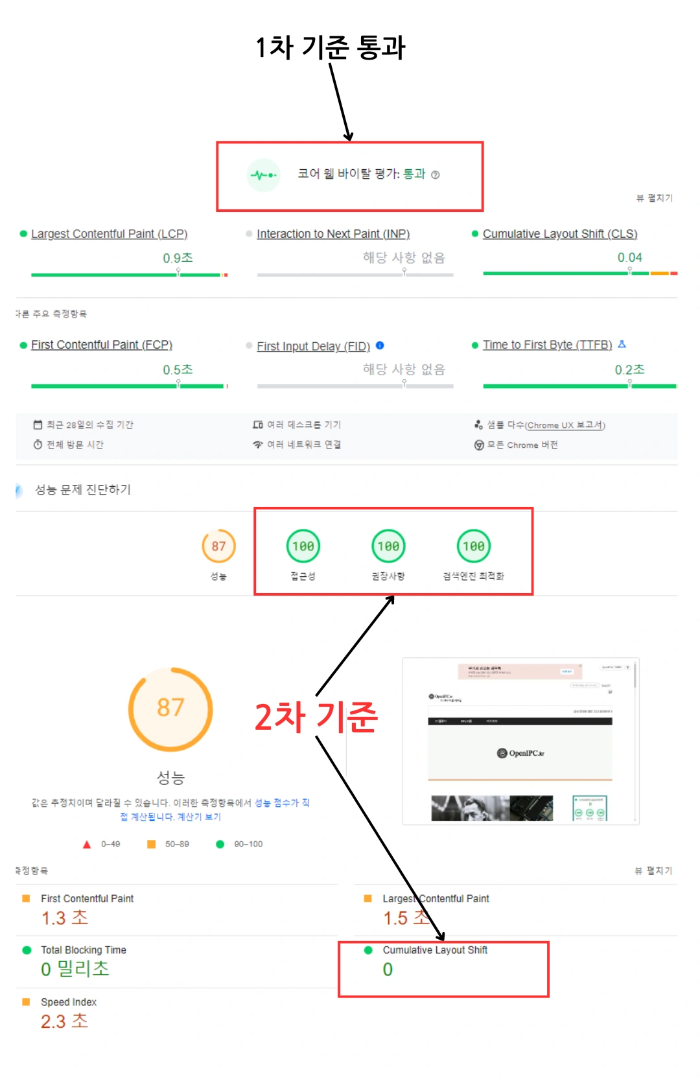
- Technical Standards (Core Web Vitals): Act as a threshold for ranking determination. If the standards are not met, the opportunity for top exposure is limited regardless of how good the content is.
- Content Quality (E-E-A-T): The factor that determines the final ranking among web pages that have passed the threshold. The E-E-A-T principle, which stands for Expertise, Authoritativeness, Trustworthiness, and Experience, is key.
Areas where technical elements can be modified: HTML, CSS, user-set scripts, image optimization, ad scripts, font loading methods, etc., which are also related to server response speed. In other words, there are parts that can be modified and parts that cannot, and server speed is classified as an external factor.
Core Web Vitals evaluations reflect changed measurements only after at least 2 to 3 months of data have accumulated, even if optimization work is performed. This is due to the accumulation period of Field Data. Additionally, performance measurement items vary depending on how videos, GIF files, and images are used when creating content.
However, among the secondary criteria, CLS (layout stability) and SEO scores should not vary depending on how content is written. Note, however, that secondary domain optimization and unique domain optimization may result in different measurements as external factor measurements are reflected.
Core Web Vitals is a Google ranking factor that measures the ‘minimum standard of user experience’ through three key metrics: LCP, INP, and CLS. On the other hand, Lighthouse is a ‘diagnostic tool’ that evaluates the overall quality of a website by comprehensively measuring five areas: performance, accessibility, SEO, and best practices. Core Web Vitals metrics are included in the performance category of Lighthouse.
Why doesn’t my search ranking rise immediately even after improving Core Web Vitals scores?
Core Web Vitals scores are measured based on actual user data (Field Data), and this data is reflected after accumulating for at least 28 days. Therefore, even if optimization is performed, it may take at least 2-3 months for the changes to be reflected in search engines and for ranking changes to appear. Furthermore, technical optimization is only a ‘prerequisite,’ and the final ranking is determined by the quality of the content (E-E-A-T).
What is the most effective way to improve LCP?
The key to LCP (Largest Contentful Paint) is reducing the loading speed of the largest content element. The most effective methods are 1) reducing server response time, 2) compressing images that serve as LCP elements and converting them to modern formats (such as WebP), 3) ensuring that images corresponding to LCP elements are not lazy-loaded, and 4) delaying the loading of non-critical CSS and JavaScript.