How to manage backlinks, a core SEO element! We have summarized the definition of backlinks, their importance in search engine optimization, natural link acquisition strategies, the risks of artificial links (link exchanges), and how to remove low-quality links using the Google Disavow Tool.
1. What are Backlinks and Why are They Important in SEO?
When running a blog or website, you often encounter the word “Backlink.” If you are studying Search Engine Optimization (SEO) or want to increase visitor numbers and search rankings, understanding the concept and management of backlinks is an essential core element.
In this post, we have organized content that can be directly applied to SEO practice, ranging from what backlinks are, the difference between natural backlinks and artificial links (link exchanges), to how to manage spammy links.
Definition of Backlinks and Their Role in Search Engines
A backlink refers to a link from another website that connects to my site. For example, if there is a link from blog A to everydayhub.tistory.com, that link becomes a backlink to my site.
Simply put,
“A link created by someone else while recommending or mentioning my blog” is a backlink.
Main Roles of Backlinks (SEO Value)
A backlink is not just an incoming link from outside; it is an important criterion for evaluating the reliability and authority of my site in search engines. Search engines consider backlinks as a kind of “recommendation vote.”
- Increased Search Rankings:
Google and Naver judge a site to be a more trustworthy source of information as it has more high-quality backlinks, exposing it higher in search results. - Increased Site Visitors:
The number of visitors (Referral Traffic) who click the link and enter directly increases. - Strengthening Domain Authority:
The SEO score of the domain itself increases, creating “Domain Power” that positively affects even newly written posts.
2. The Two Faces of Backlinks: Natural Links and Artificial Links
Not all backlinks have the same value. Naturally created backlinks are a great help to SEO, but artificially manipulated links can lead to search engine penalties. Search engines strongly dislike link manipulation.
Characteristics of Natural Backlinks
Natural backlinks are evidence that the quality of the content is high.
- When another site operator voluntarily places a link, judging it to be good content
- Example:
An IT blog quotes my post and leaves a link as reference material
A news article links to my blog post as a source
Advantages:
- Search engines evaluate them positively and reflect them in PageRank
- Credibility and search rankings rise together
Risks of Link Exchange (Reciprocal Linking)
Link exchange refers to the act of artificially exchanging links to mutually increase search rankings. It is a method of saying, “I’ll link to you, so you link back to my site.”
Characteristics:
- Easily detected by search engine algorithms (abnormal link patterns)
- The goal is ranking manipulation rather than actual visitor inflow
- Both Google and Naver pose a very high risk of penalties for violating ‘Webmaster Guidelines’
Examples:
- Blog A and Blog B placing links to each other’s main pages
- A structure where multiple blogs in a specific community take turns linking to each other
Tip
Simply recommending each other’s posts is fine, but repeating reciprocal links solely for the purpose of increasing SEO scores is considered an act of degrading search quality and becomes a problem.
Comparison of Differences Between Backlinks and Link Exchange
| Classification | Backlink (Natural) | Link Exchange (Artificial Exchange) |
| Creation Method | Occurs naturally (Editorial Link) | Artificial, intentional exchange or purchase |
| Purpose | Recognition of content value and provision of information | Search ranking manipulation |
| Search Engine Response | Positive effect and ranking increase | High possibility of penalty (Link Scheme) |
| Risk Level | Low to Medium | Very High |
3. Types and Problems of Dangerous Backlinks (Spam/Paid Links)
There are many types of backlinks, and each has a different impact on SEO. In particular, links purchased for a fee or spam links generated by automated tools are fatal to a site.
Risks of Paid / Spam Backlinks
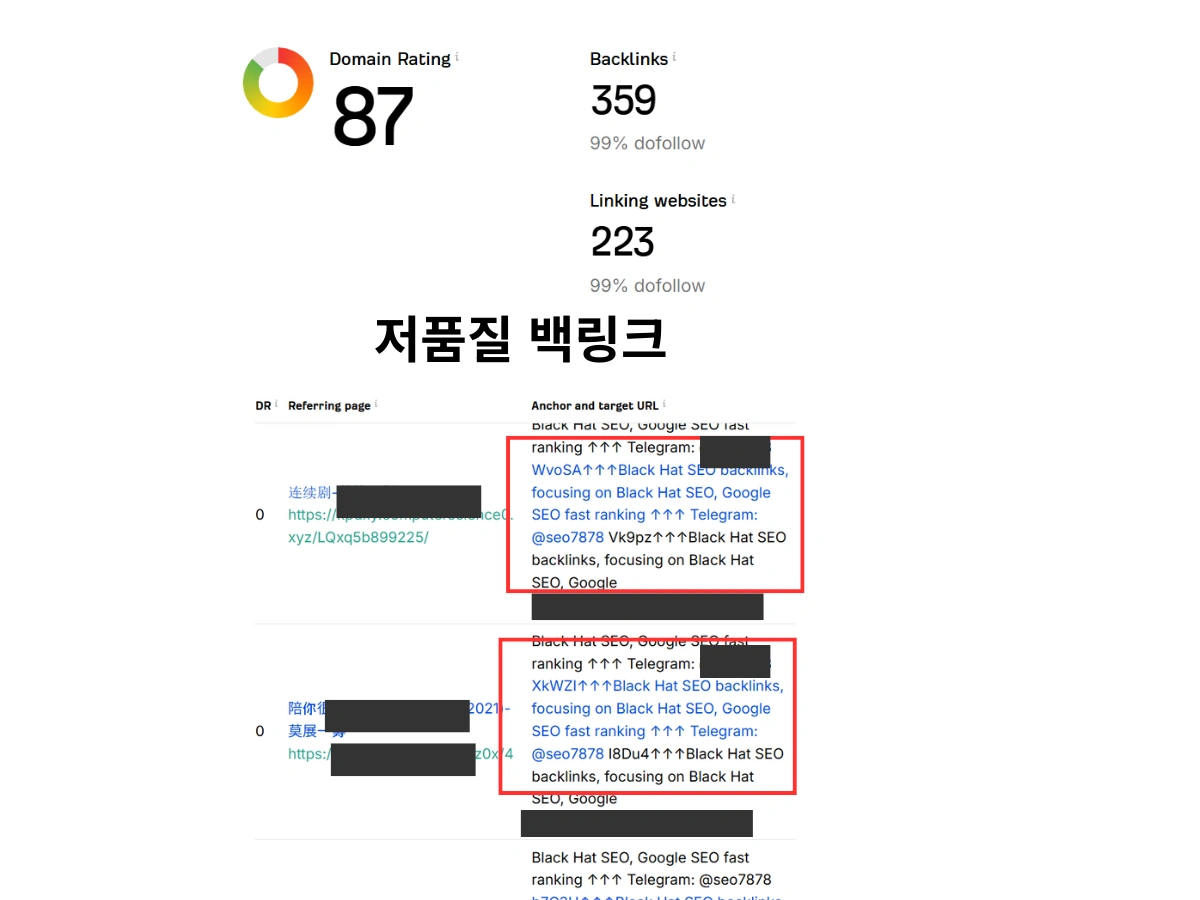
- Links purchased with money or generated in bulk using automated tools
- Often referred to as Black Hat SEO.
- Example:
- Inclusion of spam phrases like “Google fast ranking” or “Black Hat SEO”
- Advertisements selling SEO links via Telegram accounts
Caution:
These links may seem to increase rankings in the short term, but eventually Google will detect them, posing a high risk of receiving a Manual Action Penalty where the entire site is excluded from search.
Problems Caused by Dangerous Backlinks
Neglecting spammy backlinks can cause great damage to a site. This seriously damages Domain Authority, which is a reliability indicator of a website.
- Drop in Search Ranking and Index Exclusion: When Google detects manipulated links, it can drastically lower the ranking or exclude the entire site from the index.
- Damage to Domain Reputation: If connected to sites with adult, gambling, or illegal content, your own site is also recognized as low-quality.
- Meaninglessness of Duplicate/Spam Links: In most cases, although the quantity is high, there is no actual traffic and they do not help SEO scores.
4. How to Check Backlinks and Manage Spammy Links (Disavow Tool)
How to Check Backlinks
Google Search Console (Most Important)
This is the most basic and important tool. In the ‘External links’ section of the ‘Links’ menu, you can check the top linking sites and the linked text (anchor text) connecting to your site.
- Normal Signal:
0 backlinks or a small number of normal blog/company page links - Danger Signal:
Hundreds to thousands of backlinks + inclusion of many spam anchor texts such as “casino, pharmacy, adult, baccarat”
Utilizing Paid/Free Analysis Tools
- Ahrefs: In-depth analysis including DR (Domain Rating), dofollow/nofollow attributes, and spam scores
- SEMRush: Competitor backlink analysis and potential spam score provision
- Moz Link Explorer: Tracking and management of domain authority and backlinks
Removing Spammy Backlinks: Using the Google Disavow Tool
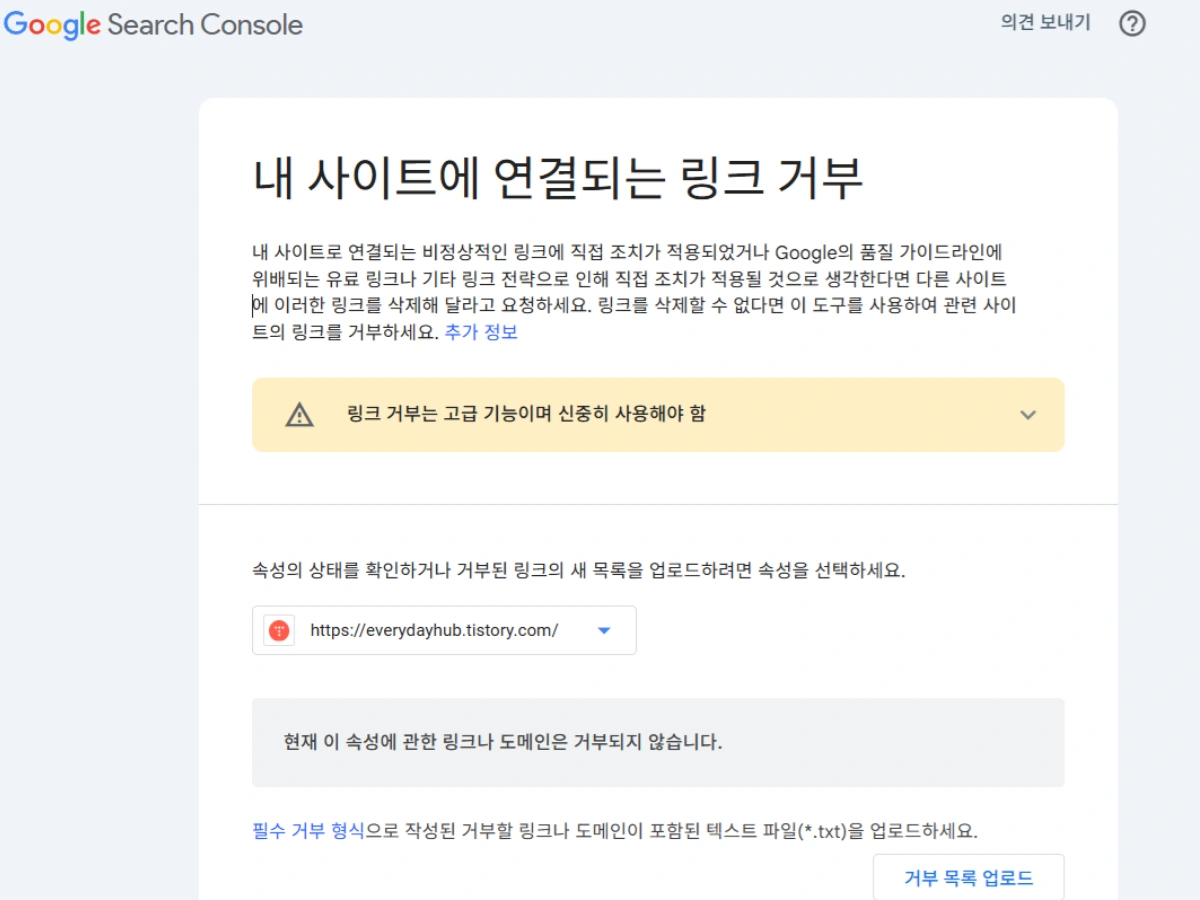
If spam links are discovered, action must be taken. The Google Disavow Tool is a tool to send a request to Google saying, “Please do not reflect this link in the evaluation of my site.” This is a final resort to prevent the degradation of search quality.
Disavow File Writing Rules and Examples
- Extension: .txt (Text file)
- Encoding: UTF-8 (Unicode)
- Content: Specify one URL or an entire domain per line.
- Lines starting with # are treated as comments and ignored by Google.
Usage Example (disavow.txt):
# Spam domain invalidation list

domain:grouse888.xyz

domain:eazyvvyj.xyz

domain:slotxo-xo.xyz

domain:spamdomain1.xyz

https://badlink.example.com/page123
⚠ Precautions: You must include only spam domains. You must decide carefully because accidentally invalidating a normal link can have a negative impact on SEO.
Go to Disavow Tool
https://search.google.com/search-console/disavow-links
Regular Backlink Monitoring and Additional Responses
- Regular Monitoring: You should check the backlink status through Google Search Console every month or quarter and immediately process a Disavow if new spam links are found.
- Tistory Response Plan: Since server settings cannot be directly changed in Tistory, you can use mitigation measures such as inserting noindex meta tags to block search crawling of spam URLs, utilizing Tistory administrator spam comment/trackback blocking functions, and using Cloudflare to block spam bot access.
5. Distinguishing and Managing Good vs. Bad Backlinks
Good Backlinks (Safe)
- Originate from trustworthy sites (high domain authority)
- Linked naturally from posts highly relevant to my content
- Example: Famous blogs, IT media, news articles, etc.
Bad Backlinks (Dangerous)
- Concentrated occurrences from low-quality domains like .xyz, .cn
- Anchor Text (link wording) containing spam words
Example: “Black Hat SEO”, “fast ranking”, Telegram addresses - Random URL formats or sites that cannot be accessed
Conclusion on Backlink Management: Trust and Honesty
Backlinks are an SEO factor that greatly helps site growth, but improper link management leads to search engine penalties.
- Actively increase naturally created backlinks,
- And strictly manage artificial link exchanges or spam links.
- Regularly check your backlink status via Google Search Console and use the Disavow Tool to invalidate them if necessary.
Summary in One Sentence
“Trust is the lifeblood of backlinks.”
Keeping only trustworthy links and cleaning up the rest is the first step to SEO success.
In the end, the core of backlink management is trust and content. Methods like excessive artificial link exchanges or purchasing paid backlinks for short-term growth may have temporary effects, but ultimately there is a risk that the entire site will be severely hit by search engine penalties. SEO is not a sprint, but a marathon. Even if it is a bit slow, the most certain and safe strategy is to consistently produce good content, gain recognition for its value, and let backlinks accumulate naturally. Because search algorithms continue to evolve, shallow methods cannot last long. Backlinks must be managed honestly and consistently. Remember that competing with your own content and sincerity, and slowly building trust rather than chasing only fast results, is the way to successful SEO in the long run.
What are backlinks and why are they important?
Backlinks are links from other websites that connect to your site. Search engines use these links as indicators to evaluate the reliability and authority of a site. Having many good backlinks is an essential element for SEO because it increases search rankings, visitor numbers, and domain reputation.
What is the difference between natural backlinks and link exchanges (artificial links)?
Natural backlinks are links voluntarily left by other sites recognizing valuable content. On the other hand, link exchanges are a method of intentionally exchanging links to mutually manipulate rankings. Search engines recognize exchange links as spam and can impose penalties on the site, so they must be avoided at all costs.
How do I manage spammy backlinks?
First, check backlinks in Google Search Console, and invalidate domains with strong spam characteristics (e.g., gambling, adult content anchor text) using the Disavow Tool. You must regularly monitor backlinks and take immediate action if suspicious links appear to prevent drops in search rankings and deterioration of domain reputation.